
An independent public resource on environmental noise pollution, including its sources, health impacts, history, and solutions.
Home / Noise Sources / Off-road Vehicles
Off-road Vehicles
The term off-road is used to describe a wide range of sport and utility vehicles designed for operation on varied terrain, including land, snow, and water.
Many off-road vehicles are marketed for recreational use and competitive sport, though some are also used for utilitarian, military, emergency response, and law enforcement purposes. Certain vehicle categories are associated with organized racing and extreme sports activities.
Noise and land-use conflicts most often arise from the unauthorized or illegal operation of off-road vehicles in areas that are not designated or zoned for their use.
In some cases, private motocross tracks or trails are constructed in residential or rural areas, generating sustained noise impacts for neighboring properties. In other cases, riders operate vehicles beyond permitted trail systems or trespass onto private land. Enforcement can be challenging due to the mobility of these vehicles and the distances officers must travel to respond to complaints.
In many states, disputes continue over the use of public lands for off-road vehicle activity. Recreation groups and industry representatives advocate for access to public trails and designated facilities for riding and racing, while conservation organizations emphasize protecting public lands from environmental degradation associated with off-road vehicle use. Concerns commonly cited include soil damage, vegetation loss, and disruption of wildlife habitat in parks and forested areas.
Beyond ecological impacts, noise from off-road vehicles alters the natural soundscape of outdoor environments. This intrusion affects nearby residents as well as visitors seeking quiet recreation such as hiking, camping, and wildlife observation.
Many off-road vehicles do not require operator licensing or formal safety training prior to use. Some vehicle types are prone to rollover on uneven or steep terrain, posing a risk of serious injury or fatality to operators.
All-Terrain Vehicle
Beyond noise impacts, ATV operation can alter natural terrain. Deep tire treads may cut channels into soil, drain wetland areas, increase sediment runoff into streams, and contribute to erosion.
Types of Vehicles
All-Terrain Vehicle
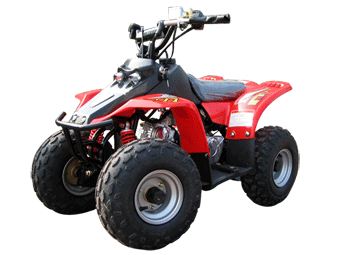
An all-terrain vehicle (ATV) is a three- or four-wheeled motorized vehicle operated with handlebars and a seat straddled by the rider. ATVs are commonly referred to as off-road vehicles and may also be called quads, three-wheelers, or four-wheelers.
Noise concerns often arise when exhaust silencers or spark arrestors are removed or modified, or when aftermarket exhaust systems lacking these components are installed. Such modifications are prohibited on all federal lands and most state-managed lands. However, enforcement of these requirements is frequently limited due to staffing constraints, terrain, and the dispersed nature of off-road riding areas.
Personal Watercraft
A personal watercraft (PWC) is a small recreational vessel that the operator sits or stands on rather than inside. These craft are powered by an inboard engine driving a jet pump, allowing them to travel at high speeds on open water. They are commonly referred to as Jet Skis, a trademarked brand name from Kawasaki.
Noise from personal watercraft can disrupt lakes, rivers, and shoreline areas used for sailing, swimming, and other quiet recreation. Their speed and maneuverability can create conflicts with swimmers and slower-moving vessels, while engine noise may also reduce an operator’s ability to hear surrounding activity or warning signals.
Snowmobile
A snowmobile is a motorized land vehicle designed for travel over snow and ice. It is propelled by a continuous rubber track and steered using front-mounted skis, powered by a two- or four-stroke internal combustion engine. Snowmobiles are also commonly referred to as snow scooters, sleds, or snowmachines.
Off-Road Bike
An off-road bike is a lightweight motorcycle designed for operation on unpaved, rough, or muddy terrain. These vehicles are commonly referred to as dirt bikes and are typically powered by single-cylinder two-stroke or four-stroke engines, with either air or liquid cooling.
Off-road bikes are used in organized competitive activities, including motocross, supercross, enduro racing, and timed or speed-based trials.
Dune Buggy
A dune buggy, also known as a beach buggy or sand buggy, is a motorized vehicle designed for operation on sand dunes and beaches. These vehicles typically feature large, wide tires and an open-frame or lightweight chassis. Variants include smaller off-road go-karts used for recreational riding.
Motorized Scooter
A motorized scooter is similar in form to a foot-powered kick scooter, featuring a narrow standing platform and handlebar steering. Some models include a seat. Electric scooters generally produce low noise levels, while gas-powered models can generate significant noise. As a result, the use of gas-powered scooters is restricted or prohibited in many municipalities.
Minibike
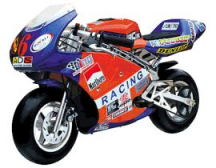
A minibike is a small motorcycle-style vehicle, commonly referred to as a mini-motorcycle, pocket bike, or pocket rocket. These vehicles are typically powered by small two-stroke internal combustion engines. Despite their size, some models are capable of reaching relatively high speeds. While originally marketed for children, many minibikes are modified for adult use through changes such as taller handlebars.
Minibikes are also used in organized competitive activities, including pit bike racing, minimoto, and Mini GP racing.
Due to safety concerns and a history of serious and fatal accidents, many states have enacted laws restricting or prohibiting minibikes from operating on public roadways.
Minibike
A typical minibike with a low profile. Due to their small size and low riding height, these vehicles may be less visible to pedestrians and motorists, particularly in traffic or crowded areas.
Industry
Major manufacturers of off-road vehicles include Kawasaki, Yamaha, Razor, Bombardier Recreational Products, and John Deere. Manufacturers and retailers commonly market these vehicles through lifestyle magazines, digital media, and television.
Numerous industry and rider organizations are active in off-road vehicle advocacy and promotion. These include the Personal Watercraft Industry Association, International Snowmobile Manufacturers Association, BlueRibbon Coalition, American Sand Association, California Off-Road Vehicle Association, Tread Lightly!, National Off-Highway Vehicle Conservation Council, and the All-Terrain Vehicle Association.
Legislation
In communities that have attempted to regulate off-road vehicle activity, organized opposition has sometimes emerged from riders and advocacy groups concerned about access and recreation.
Zoning and land-use ordinances are among the most effective tools available to local governments for addressing off-road vehicle impacts. These ordinances define permitted and prohibited land uses and are intended to prevent activities that create undue noise, dust, or other harms to neighboring residents and businesses.
See Also
Health
Research, public health findings, sound measurement, and the effects of noise on sleep, stress, hearing, cardiovascular health, and learning.
Copyright © 2004-2026 NoiseOFF. All rights reserved. Read our Privacy Policy.