
An independent public resource on environmental noise pollution, including its sources, health impacts, history, and solutions.
Home / Noise Sources / Low-Frequency Sirens
Low-Frequency Sirens
Low-frequency siren systems are supplemental warning devices used on emergency vehicles that emit non-directional sound that is not only audible but can also be felt, including within nearby vehicles and structures.
Conventional emergency sirens are designed to project sound directionally toward oncoming traffic to provide situational awareness.
Agencies that deploy these systems characterize them as advanced warning technologies intended to improve safety at intersections and in areas with congested traffic.
The use of low-frequency sirens introduces a distinct impact on surrounding communities. Because low-frequency sound travels farther and penetrates buildings, affected residents experience intense noise and vibration inside their homes, raising concerns about involuntary exposure and the cumulative effects of repeated use in urban environments. Secondary effects can include triggering vibration-sensitive car alarms.
The Rumbler siren is most commonly referred to as a low-frequency emergency siren (or low-frequency siren).
Operational Context
In emergency response terminology, a “Code 3” response refers to an emergency mode in which an authorized emergency vehicle proceeds through traffic with warning lights activated and sirens engaged. While siren use is intended for emergency situations, activation may also occur at the discretion of vehicle operators in non-emergency circumstances, even when agency policies discourage siren use outside of emergency response.
Low-frequency siren systems can be compared to other sound-based control technologies, such as the Long Range Acoustic Device (LRAD), in that they rely on acoustic force to influence behavior and perception. The increasing use of sound-based technologies in urban environments has raised questions about exposure, effectiveness, and potential impacts on public health and quality of life.
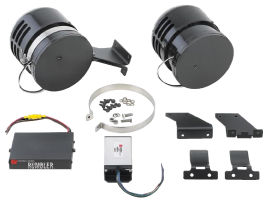
Rumbler Siren Components
In addition to a primary siren amplifier and speaker, a secondary amplifier drives a pair of high-output woofers to generate low-frequency sound.
Industry
Federal Signal Corporation is the manufacturer of the Rumbler siren. The company supplies audible and visual signaling systems, warning equipment, and communications products for industrial, transportation, and public safety markets.
It markets the Rumbler as an intersection-clearing device for urban environments with high levels of traffic.
It emits duplicated low-frequency tones that, according to the company, “have the distinct advantage of penetrating and shaking solid materials, allowing vehicle operators and nearby pedestrians to FEEL the sound waves, and perhaps even see their effects through a shaking rearview mirror.”
Federal Signal Corporation is a member of the National Association of Electrical Distributors (NAED), a trade organization representing companies in the electrical distribution industry.
Whelen Engineering Company, Inc. manufactures the Howler low-frequency tone siren. The company also designs and markets audio and visual signaling devices primarily for law enforcement, emergency services, security, and military applications.
Legislation
There is no known publicly available research evaluating the effectiveness, necessity, or community impacts of low-frequency siren deployment. In addition, there is no evidence of formal public review or hearing processes specifically addressing their use, exposure effects, or long-term implications in residential environments.
Adoption of low-frequency sirens have not been limited to large or densely populated jurisdictions. Police departments in small municipalities have also equipped patrol vehicles with low-frequency sirens as part of their emergency warning systems.
History
Until the early 2000s, conventional emergency vehicle sirens were predominantly high-frequency and directional in nature. Their primary function was to alert oncoming motorists and nearby road users to the presence of an approaching emergency vehicle, allowing traffic to yield appropriately. The sirens were largely experienced at street level and not designed to propagate extensively into surrounding buildings.
The introduction of low-frequency siren technology represented a significant departure from earlier warning systems. Unlike traditional, directional siren tones, low-frequency sound radiates in an omnidirectional manner. As a result, it travels farther, penetrates buildings and other structures, and spreads into areas where it provides little or no situational guidance. Pedestrians and motorists not directly in the path of an approaching emergency vehicle may hear and feel the siren without being able to determine the vehicle’s direction or proximity.
Because this shift occurred gradually and without broad public discussion, residents often lacked the language or technical framework to describe how and why these sirens differ fundamentally from earlier warning signals. For many years, the effects of low-frequency sirens were assumed to be a normal characteristic of emergency response rather than the result of a distinct technological change.
A Florida highway patrol officer conceived the device after observing the low-frequency impact of bass-heavy audio systems used in boom cars.
Occupational Exposure and Litigation
Various firefighters and emergency responders have brought lawsuits alleging hearing loss associated with prolonged exposure to emergency vehicle sirens manufactured by Federal Signal Corporation. These claims generally focused on occupational exposure inside vehicle cabs and raised questions about sound levels, product design, and the adequacy of warnings or protective measures.
Over time, these cases proceeded through a combination of individual lawsuits, consolidated claims, and limited settlement agreements. Outcomes varied by jurisdiction and circumstance, with some claims resolved through settlements and others resulting in defense verdicts or dismissals. Efforts to pursue broad class-action certification were challenged in court and did not result in a single, sustained nationwide class action judgment against the company.
While this litigation did not center exclusively on low-frequency sirens such as the Rumbler, it reflects ongoing concerns among emergency personnel regarding repeated exposure to high-intensity sound and vibration during routine operations. The legal history highlights unresolved questions about long-term exposure, occupational risk, and the balance between warning effectiveness and auditory safety.
New York City Police Department
When the New York City Police Department first announced its deployment of low-frequency sirens, media coverage largely framed the technology as a technical upgrade. Little attention was given to questions regarding long-term exposure, residential impact, or the broader implications of introducing low-frequency sound into dense urban environments.
The NYPD procured and deployed the equipment without a publicly documented review process or impact assessments focused on noise exposure. Oversight of the department falls under the jurisdiction of the New York City Council’s Public Safety Committee. No public hearings were held regarding the potential community impacts of the technology.
Residents living near major thoroughfares, police precincts, and frequent response routes experience repeated exposure to intense low-frequency noise and vibration.
In one newspaper article, an NYPD official suggested that New Yorkers should take it in stride, “the way New Yorkers do.” That statement does not address the experience of vulnerable populations, including children, older adults, and individuals who are convalescing.
According to reporting in The Wall Street Journal, Robert Martinez, then Director of Fleet Services for the NYPD, stated that the sound levels produced by the device measured lower on the decibel scale than those of traditional sirens. This comparison, however, reflects overall sound pressure levels and does not account for the differing propagation characteristics of low-frequency sound, including its ability to penetrate buildings and produce vibration.
NYPD Demonstrating the Rumbler Siren
The New York City Police Department demonstrating the Rumbler siren. The department discussed the possibility of an accompanying public education campaign to reduce public concern.
See Also
Health
Research, public health findings, sound measurement, and the effects of noise on sleep, stress, hearing, cardiovascular health, and learning.
Copyright © 2004-2026 NoiseOFF. All rights reserved. Read our Privacy Policy.