
An independent public resource on environmental noise pollution, including its sources, health impacts, history, and solutions.
Home / Noise Sources / Electric Vehicles
Electric Vehicles
Our use of the term Electric Vehicles (EVs) describes hybrid electric vehicles, plug-in hybrid electric vehicles, and all-electric vehicles.
The evolution of the EV is a promising automotive solution that reduces maintenance costs and dependence on foreign oil. It also reduces exhaust and noise emissions.
People who live near busy roadways, thoroughfares, intersections, and parking lots are exposed to vehicle noise at all hours. Because electric motors produce less sound than Internal Combustion Engines (ICEs), which require a tailpipe muffler to mitigate noise emissions, EVs improve the urban soundscape. Consumers are attracted to EVs because they are quieter vehicles.
Artificial Vehicle Sound (AVS) refers to externally generated sounds required on some electric vehicles under pedestrian safety regulations and implemented through vehicle-mounted loudspeakers. In practice, manufacturers have also used these systems to introduce customizable vehicle sounds associated with brand identity.
AVS has shifted from voluntary or experimental features to mandatory safety requirements in many parts of the world. The European Union, Australia, Japan, and South Korea require electric and hybrid vehicles to be equipped with AVS at low speeds. Additional countries have introduced or are proposing comparable regulations.
As a result, AVS has become an increasingly global regulatory standard, with little consideration given to noise or environmental impacts.
Artificial Vehicle Sound
The technology to produce AVS consists of external loudspeakers and a controller device that imitates ICE noise or branded sound effects by automakers. It may be possible for consumers to add custom sounds or increase the volume by modifying the electronics on the vehicle.
Auto companies develop custom sounds for their EVs that go beyond imitating the sound of a slow-moving vehicle. AVS conveys marketing messages through sound effects. These vehicles use external loudspeakers, which have the effect of keeping the passenger compartment quiet while the noise is projected outside.
Automakers recognize that, in the same way mobile phone ringtones convey a brand, vehicles can use distinct sounds to convey their own brand, at the expense of people who are exposed to unwanted noise.
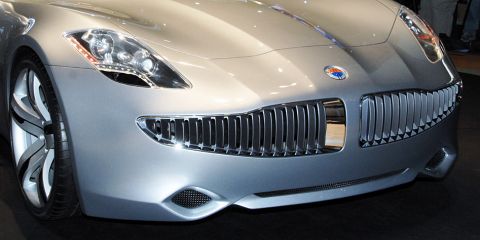
Fisker Karma Plug-In Hybrid
The Fisker Karma plug-in hybrid used a set of loudspeakers embedded in the front of the vehicle. A company representative described the sound as a mix between a “Formula One car and a starship.”
Legislation
The National Federation of the Blind (NFB), an organization representing blind people, lobbied the United States government to mandate AVS on EVs. They claim that EVs pose a safety risk to sight-impaired pedestrians who rely on hearing an approaching vehicle to judge its speed and proximity while navigating intersection crosswalks and other traffic situations.
When the NFB first announced that EVs presented a danger, media attention was considerable; however, few questions were raised about the impact of increased noise pollution.
In 2007, the NFB funded a start-up company called Enhanced Vehicle Acoustics to design external loudspeakers for EVs. The company built prototypes for use on the Toyota Prius with the intention of licensing its technology to automakers.
In 2008, the NFB funded a University of California study that evaluated the effect of sounds emitted by EV and ICE vehicles traveling at five miles per hour. Subjects claimed they could detect the sound of an internal combustion vehicle when it was twenty-eight feet away, but could not detect the sound of a hybrid vehicle until it was seven feet away.
A controlled laboratory experiment is inherently different from the environment of city streets, where the din of traffic often masks the sounds of individual vehicles in motion. Most vehicles produce low-frequency sound energy that is non-directional. The broader implication is that any type of vehicle, including motorcycles, scooters, mopeds, and bicycles, also presents a danger to blind pedestrians.
In 2008, the NFB lobbied the National Highway Traffic Safety Administration (NHTSA) to hold a public hearing on the issue and called on government policymakers, automotive industry representatives, and blind advocates to testify.
The NFB lobbied the United States Congress to enact legislation that would direct the Secretary of Transportation to study and establish a motor vehicle safety standard that provides a means of alerting blind and other pedestrians to motor vehicle operation.
In 2009, NHTSA released a technical report titled “Incidence of Pedestrian and Bicyclist Crashes by Hybrid Electric Passenger Vehicles” (DOT HS 811 204), comparing the incidence rates of pedestrian and bicyclist crashes involving EVs and ICE vehicles under similar circumstances.
A total of 77 pedestrians and 48 bicyclists involved in crashes with EVs were sampled, compared to 3,578 pedestrians and 1,862 bicyclists involved in crashes with ICE vehicles. Within the sample group, there was a statistical difference in cases where EVs had a higher incidence rate when backing up or making a turn at slow speeds. There was no difference when both types of vehicles were traveling straight. There was no mention of whether any of these accidents were caused by extraneous circumstances, such as distracted drivers or pedestrians.
NHTSA noted that the results of the study were not intended to make national estimates on the issue because they were based on a small sample size. That did not prevent NHTSA and the NFB from prominently citing the report in national media coverage.
In 2011, the Pedestrian Safety Enhancement Act was signed into law. The act does not mandate a specific speed for AVS, but it requires the DOT to study and establish requirements for sound levels on EVs.
There are differences in sound energy. For example, the Occupational Safety and Health Administration (OSHA) mandates the use of back-up alarms on trucks for safety. However, the intense, piercing noise emitted from conventional back-up alarms is a noise hazard. Improved back-up alarms emit a broadband sound (white noise) that dissipates over a discrete distance, reducing noise pollution. OSHA has not acted to mandate broadband sound, despite repeated calls to do so. As NHTSA’s mandate does not include noise pollution, noise control considerations are not formally represented in the rulemaking process.
While the United States Congress has recognized the deleterious effects of noise pollution, no federal agency is mandated to monitor its health and environmental consequences. This includes the Environmental Protection Agency (EPA), whose Office of Noise Abatement and Control (ONAC) was defunded. As a result, there are no AVS standards based on public health considerations.
NHTSA published a proposed rule that requires all EVs traveling at less than 18.6 miles per hour to emit AVS; however, automakers are given full discretion over the sounds their vehicles make. The rule went into effect in 2014.
There were technologies that could alert blind pedestrians to the presence of EVs.
One proposed solution was a receiver device that sight-impaired individuals could wear, which would emit an audible alert when an EV was in close proximity. EVs equipped with a transmitter would send a signal to the device relative to distance. This approach would have produced a discreet alert for blind pedestrians and would have had no effect on increasing ambient noise pollution.
This concept was rejected by the NFB in favor of external loudspeakers on all EVs.
Boy Hit by Hybrid Car Claim
The National Federation of the Blind generated national news coverage by emphasizing the perceived dangers of quiet hybrid vehicles.
Industry
Why were automakers and technology companies eager to develop AVS?
By aligning with the NFB and voluntarily adding external noise to vehicles, the auto industry sought to preempt additional government regulation. Anticipating that AVS might be mandated, automotive and technology companies also identified potential opportunities through patent licensing fees for AVS systems.
Some consumers held negative perceptions of EVs as small, underpowered, range-limited, or lacking excitement. Rather than marketing a vehicle that was simply quiet, automakers positioned sound as futuristic and high-tech. The marketable “look at me” message became part of the new-car experience, with AVS recreating the aggressive “vroom vroom” quality that some consumers associated with performance and desirability.
The Society of Automotive Engineers (SAE) created a “Safety and Human Factors Committee” to quantify the sound levels emitted by EVs. The SAE had previously collaborated with the American Motorcyclist Association to create a system for measuring sound from motorcycle exhaust systems, which critics argued was intended to obfuscate label match-up, an effective method for curbing motorcycle noise.
The irony is that the auto industry has historically resisted safety improvements, such as seat belts (invented in the 1880s and not widely implemented until the 1950s) and airbags (invented in the 1950s and not widely implemented until the 1980s). In the case of AVS, the industry moved quickly to develop a solution to a problem that had not been clearly established. Moreover, critics argued that industry-led safety messaging was being used to influence public perception and regulatory outcomes.
An aftermarket parts supplier, Sigma Automotive, sold aftermarket hot-rod exhaust systems for the Toyota Prius on the basis that exhaust noise improved safety. As the vehicle did not displace exhaust gases in battery mode, the logic of turning the Prius into a muscle car for safety was fundamentally flawed.
Tesla’s former “Boombox” feature demonstrated how externally mounted pedestrian warning speakers could be repurposed for non-safety audio. The feature allowed drivers to play music and sound effects through the vehicle’s external speaker while the vehicle was in motion.
In 2022, the National Highway Traffic Safety Administration (NHTSA) determined that this use violated federal motor vehicle safety standards and required Tesla to disable the feature during driving via a software update. The action underscored that pedestrian warning systems were not intended to function as customizable or entertainment-based noise sources.
General Motors (GM) collaborated with the NFB to add AVS, which it referred to as “Safe Sound Alert.” In 2010, the automaker introduced its “Pedestrian-Friendly Alert System,” a manually activated feature on the Chevrolet Volt. The system used the vehicle’s horn to emit warning chirps intended to alert pedestrians.
Ford Motor Company designed its own AVS for the Ford Focus Electric and polled consumers on Facebook to select their preferred sound.
Mercedes-AMG plans to equip future electric models with synthesized engine sounds designed to emulate the character of traditional V8 engines. In addition to the sound itself, the system is intended to simulate rapid gear changes, creating brief interruptions in the audio to mimic the behavior of a multi-speed exhaust note. The speaker enclosure is capable of producing low-frequency, powerful bass sounds. According to AMG CEO Michael Schiebe, “I’m super-confident that we will convince the strongest petrolheads with this car.”
Dodge has developed a patent-pending “Fratzonic Chambered Exhaust” system for its electric Charger Daytona models that deliberately recreates the noise of a gasoline-powered muscle car. The system uses a combination of chambered airflow paths and speakers to generate a synthesized exhaust sound intended to match the approximately 126-decibel output of a Hellcat V8. The company has stated that this approach reflects its view of what an electric muscle car should sound like.
Porsche equipped its first electric vehicle with “Porsche Electric Sport Sound,” designed to give the car a science-fiction-inspired sound effect. Rather than synthesizing traditional internal combustion engine noise, it amplifies the sounds produced by the electric motor.
Hyundai has disclosed a patent for an advanced electric vehicle sound system designed to enhance the perceived “feel” of driving an EV through synthesized engine audio. Their system uses a multi-speaker setup that simulate the revs, pops, and character of an internal combustion engine. Hyundai describes the goal as delivering an improved sound experience for drivers and pedestrians, noting that existing EV and hybrid sound systems can “cause discomfort for both drivers and pedestrians.”
Nissan had consulted with the NFB on the development of its AVS, as well as with a Hollywood sound design studio. Its sound engineers worked with film composers to create custom sounds that were described as being reminiscent of the futuristic flying cars depicted in the dystopian motion picture Blade Runner.
Fisker Automotive, now defunct, introduced the Fisker Karma plug-in hybrid sports car in 2010. The vehicle used external loudspeakers to emit a custom sound. The company also consulted with a entertainment-industry sound design studio during the development of its sound.
Lotus Engineering is a consultancy group of the British sports carmaker Lotus Cars. Harman Becker Automotive Systems is a division of Harman International Industries. The two companies collaborated to develop AVS systems with the intention of marketing the technology to other automakers.
Their “HALOsonic Internal and External Electronic Sound Synthesis” system generated engine sounds inside and outside the vehicle, with driver-selectable sound profiles.
Lotus Cars and Harman International Industries also created a hybrid demonstrator vehicle that simulated gasoline engine noise using loudspeakers rated at 300 watts each. The companies referred to it as a “Safe & Sound” vehicle.
Harley-Davidson LiveWire Electric Motorcycle
As exhaust noise from motorcycle straight pipes is often justified by riders as a means of reducing accidents, AVS has similarly been positioned as a safety feature. In this case, the electric motorcycle emits an artificial sound likened to either a fighter jet or a vacuum cleaner.
See Also
Health
Research, public health findings, sound measurement, and the effects of noise on sleep, stress, hearing, cardiovascular health, and learning.
Copyright © 2004-2026 NoiseOFF. All rights reserved. Read our Privacy Policy.