
An independent public resource on environmental noise pollution, including its sources, health impacts, history, and solutions.
Home / Noise Sources / Car Alarms
Car Alarms
A car alarm is an electronic device designed to deter vehicle theft. Car alarms sound off when the vehicle’s sensor detects vibration, movement, contact, or noise. A passing vehicle or other external vibration can set off an alarm.
Some alarms use audible status indicators that sound off whenever there is any vibration or sound outside the vehicle. Keyless entry systems use the alarm simply to signal the motorist that the alarm is enabled or disabled.
For all the noise they create, there is absolutely no evidence that car alarms work. Auto thieves intentionally trip car alarms to mask the sound of breaking glass. Thieves can disable an alarm in seconds. People do not respond to car alarms and will take no action to reduce an auto theft in progress.
Car Alarm Components
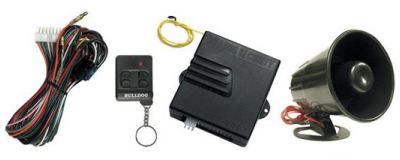
An aftermarket car alarm system typically consists of a wiring harness, remote transmitter, onboard sensor device and a horn. Most new vehicles include factory installed alarms, which means consumers essentially pay a car alarm tax.
Industry
The largest manufacturer of aftermarket car alarms is VOXX International. They acquired the majority of Directed Electronics’ automotive aftermarket business, including the brands AstroStart, Automate, AutoStart, Avital, Clifford, Python, and Viper. Other brands they own include CrimeStopper, Bulldog Security, K-9, and Excalibur.
While not a car alarm product, under the brand name, Aggressor Air Horns, they also market specialized horns for vehicles, advertised as the “loudest, highest-quality train horn kits on the market—built to turn heads and make an impact.”
These companies are members of the Consumer Electronics Association (CEA) and the Specialty Equipment Market Association (SEMA). Along with the Mobile Enhancement Retailers Association (now known as the Mobile Electronics Association), representing dealers and installers, they have lobbied against proposed noise-pollution ordinances in communities across America.
Directed Electronics was founded by Darrell Issa. As a former chairman of the Consumer Electronics Association, Issa was active in lobbying efforts opposing proposed noise ordinances. His business in the electronics industry preceded his entry into public office as a Congressman from California.
SEMA published an interview with him called “One of Our Own” about his legislative efforts favorable to their member companies. He is a member of the Congressional Automotive, Performance and Motorsports Caucus, in part founded by SEMA.
Firstech, LLC, owns the brand name Compustar, a manufacturer of aftermarket car alarm, remote start, and vehicle security systems.
Legislation
In 2004, an organized campaign sought to ban car alarms in New York City. Residents affected by car alarm noise testified at public hearings and organized demonstrations outside City Hall in support of the proposed ban.
The New York City Police Department (NYPD), which oversees the Department of Environmental Protection (DEP), testified against the ban. The NYPD argued that car alarms provided an additional layer of protection for motorists’ property, but did not present data or studies demonstrating that alarms reduced vehicle theft.
This position conflicted with the NYPD’s earlier assessment in a 1994 publication, Police Strategy No. 5: Reclaiming the Public Spaces of New York (City of New York), which stated that unattended noise and disorder—including car alarms—contributed to perceptions of neglect and declining public safety.
Representatives from MERA, CEA, Directed Electronics, Audiovox and Toyota also testified against the proposed ban.
City Hall ultimately passed a weakened ordinance that prohibited the sale of motion-activated alarms and alarms that sound for more than three minutes.
Following the vote, MERA issued a press release stating that “the language of the proposed ordinance has been amended to soften the blow to the mobile electronics industry.”
See Also
Health
Research, public health findings, sound measurement, and the effects of noise on sleep, stress, hearing, cardiovascular health, and learning.
Copyright © 2004-2026 NoiseOFF. All rights reserved. Read our Privacy Policy.