
An independent public resource on environmental noise pollution, including its sources, health impacts, history, and solutions.
Home / Education / Fundamentals of Sound and Hearing
Fundamentals of Sound and Hearing
What Is Sound?
Sound is anything that can be heard in our environment, including voices, music, natural sounds, and noise from machinery. Sound helps us understand our surroundings by allowing us to communicate, enjoy music, and recognize warnings or danger.
Sound can also be felt through the human body. Loud and low-frequency sounds are often experienced as vibrations.
- What are your favorite sounds?
- What kinds of sounds might alert you?
- What kinds of sounds can you hear and feel?
How Does the Human Ear Work?
The Human Ear
The human ear has three main sections that work together to turn sound waves into signals the brain can understand. Having two ears allows us to tell whether a sound is coming from the left, the right, or straight ahead.
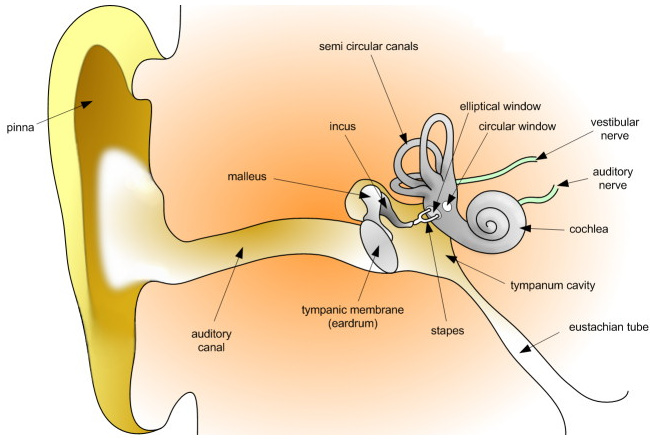
The human ear has three sections: the outer ear, the middle ear, and the inner ear. The shape of the outer ear (pinna) helps direct sound through the auditory canal to the eardrum. The eardrum is a delicate membrane that vibrates in response to sound waves.
These vibrations are passed to three tiny bones in the middle ear: the hammer (malleus), the anvil (incus), and the stirrup (stapes). In the inner ear, the stirrup touches a liquid-filled structure, and the vibrations travel through the cochlea. Inside the cochlea, thousands of tiny hair cells connected to nerve fibers transmit sound information to the brain through the auditory nerve.
Each part of the ear is tiny and highly sensitive. Exposure to loud or prolonged noise can damage the hair cells, permanently altering the transmission of sound.
Unfortunately, over the course of a lifetime, most people will lose a percentage of their hearing due to noise pollution.
What Is Noise Pollution?
Noise pollution is unwanted, human-created sound that can be annoying, distracting, painful, or physically harmful. The word noise comes from the Latin word nausea, meaning seasickness.
Environmental sound is not necessarily noise pollution. For example, the sound of a thunderstorm is not considered noise pollution.
- Can you describe three sources of environmental sound?
- Can you describe three sources of noise pollution?
What Is a Decibel?
Alexander Graham Bell
Alexander Graham Bell, the scientist and inventor best known for the telephone (1876), at the opening of the New York–Chicago long-distance line in 1892.
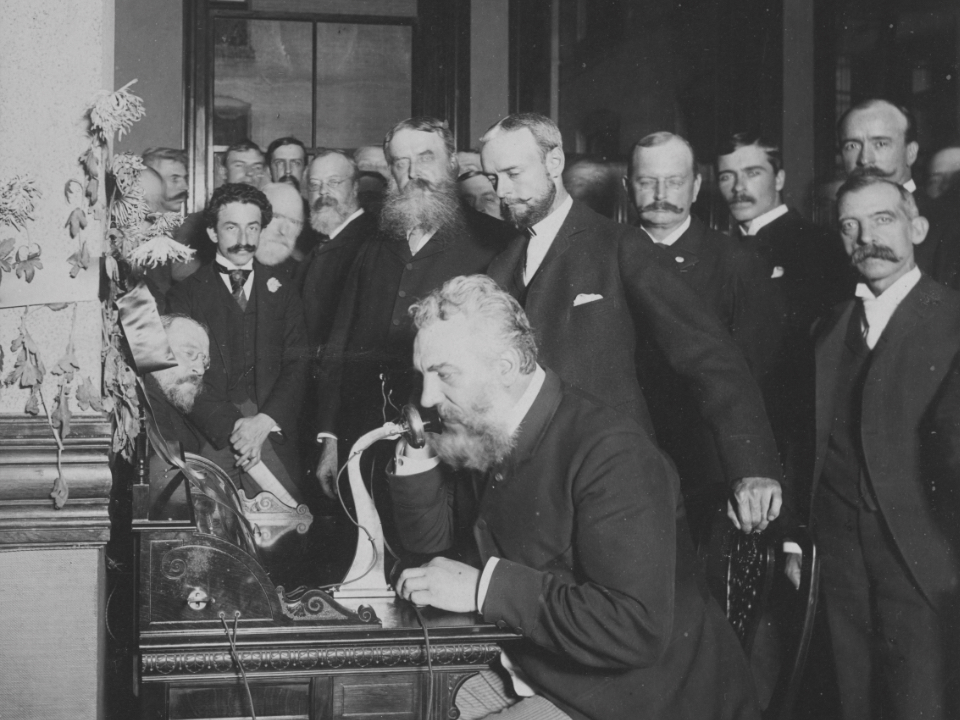
The word decibel comes from two parts: deci, meaning one-tenth, and bel, named after Alexander Graham Bell, who studied sound and communication. A decibel is a way to describe how loud a sound is. The decibel scale is designed to match how human hearing works, so the numbers increase differently than they would on a simple counting scale.
A decibel (denoted as dB) is a unit used to measure sound. The “A” standard is a filter designed to reflect typical human hearing. The “C” standard is used to measure lower-frequency sound, which is more likely to be felt as vibration.
Decibels are measured on a logarithmic scale. Unlike a regular counting scale, where numbers increase evenly, a logarithmic scale increases by larger jumps at each step. An increase of 10 decibels sounds about twice as loud to the human ear, even though the number itself increases by only ten.
Understanding how decibels work helps explain why certain sounds can cause stress, sleep disruption, or other health effects, even when they do not initially seem extremely loud.
Below is a decibel scale showing different types of sounds and their general effects on hearing.
| Type of Sound | Decibel (dB) | General Effect |
|---|---|---|
| Jet Takeoff | 150 | Risk of Immediate Hearing Damage |
| Train Horn | 130 | Risk of Hearing Damage |
| Car Alarm | 120 | Near Pain Threshold |
| Leaf Blower | 100 | Increased Risk of Hearing Loss |
| Motorcycle | 90 | Prolonged Exposure Risk |
| Traffic Noise | 80 | Loud |
| Vacuum Cleaner | 70 | Intrusive |
| Conversation | 50 | Baseline |
| Whisper | 30 | Very Quiet |
| Breathing | 20 | Barely Audible |
How Can You Protect Your Hearing?
The simplest way to protect your hearing when exposed to loud noise is to cover your ears with your fingers or the palms of your hands.
When using a portable music player, television, or stereo system, adjust the volume so it does not prevent you from hearing other sounds in your surroundings. If you experience discomfort or ringing in your ears, the sound is too loud.
- What other ways can you protect your hearing?
You can also protect the hearing of others by being considerate and avoiding the creation of excessive noise.
Copyright © 2004-2026 NoiseOFF. All rights reserved. Read our Privacy Policy.