
An independent public resource on environmental noise pollution, including its sources, health impacts, history, and solutions.
Home / Publications / Loud Motorcycles / The Label Match-Up Program
The Label Match-Up Program
Two key elements of the label match-up are contained in the federal regulations. They are noise emissions testing and labeling. This applies to street[1] (highway use) and off-road[2] (dirt bikes) motorcycles manufactured after December 31, 1982, which are for sale in the U.S.
The EPA chose not to enforce noise emissions standards (noise level testing) on motorcycles that are for competition use[3] or export, and on motorcycle exhaust systems that are for export, pre-regulation motorcycles, and competition use. However, they do require labeling for these exhaust systems[4] and motorcycles[5] as a means to identify what (export) and where (competition events) these exhaust systems are to be solely used, and the type of motorcycle (pre-regulation or competition models) on which they are installed.
Noise Emissions Testing
The EPA sets the maximum noise emissions levels[6] by measurement under a strict, scientifically derived testing procedure (SAE J331a)[7] to recreate the vehicle’s maximum noise levels while under heavy acceleration. This test represents what can be expected in actual real-world use. Currently, the maximum noise emissions are 80 dB(a) for street motorcycles. This current noise emissions limit (or cap) offers the minimum level of protection to the public.
Labeling
Once the motorcycle successfully passes the noise emissions test (J331a), two labels (one on the vehicle chassis and the other on the vehicle muffler) are required to be affixed in a “readily visible position” at the factory. Both of these labels contain an identical model-specific code[8] (along with other information) that is unique to the make and model of the motorcycle. The comparison of the model-specific code between the two labels provides a way to “match up” the muffler to the motorcycle.
A regulated motorcycle that has an exhaust system installed without the correct label (i.e., competition use, pre-regulation, export only, or no label at all), or has an exhaust system from a different make and model of motorcycle (non-matching model-specific codes), is in violation of federal regulations and section 4909(a)(2) of the Noise Control Act (NCA).
The label match-up, quite simply, eliminates all ambiguity as to what is or is not a suitable motorcycle muffler. It greatly lightens the burden on police, who normally would have to place a subjective value such as “excessive” or “unusual” on motorcycle exhaust noise, by instead just requiring a simple visual check for the correct muffler label and model-specific code. Enforcement is this easy. No sound level meters or special skills are required.
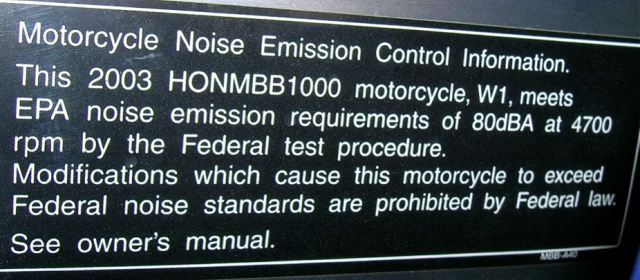
The first is the “motorcycle noise emissions control information label” affixed to the motorcycle chassis (as defined and required by 40 CFR 205.158). This label includes the model year, a model-specific code that only appears on an approved muffler designed for a specific vehicle, engine RPM during the federal test procedure, the statement “this motorcycle meets EPA noise emissions requirements of either 83 dB(a) or 80 dB(a),” and a warning that “tampering” is in violation of federal law.
These two photos are from a 2003 Honda VTR 1000F “Super Hawk.” Additional examples of match-up labels are included in Appendix I.
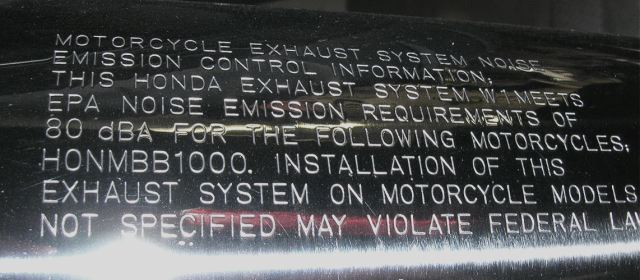
The second is the “exhaust system noise emissions control information label” to be affixed to the quiet and tested muffler (as defined and required by 40 CFR 205.169a(1)). This muffler label generally states that the exhaust system meets EPA noise emissions requirements and includes the manufacturer’s name, noise emissions limit, and a unique model-specific code (HOMMBB1000 in these photo examples) that only appears on the motorcycle’s “motorcycle noise emissions control information label” (previous photo) for which this exhaust system is designed.
In practical use, label match-up is easier than it sounds. Since label match-up is an equipment requirement, enforcement “will not require the vehicle to be in operation or the driver to be present in order for a citation to be made[9].” Secondly, police will not need to compare model-specific codes from both labels because, when they stop or inspect the exhaust system of a loud motorcycle, they will find:
- The overwhelming majority of loud federally regulated (1983 and newer) motorcycles are equipped with illegal aftermarket exhaust systems that are completely void of federally required labeling. See Appendix II for photo examples.
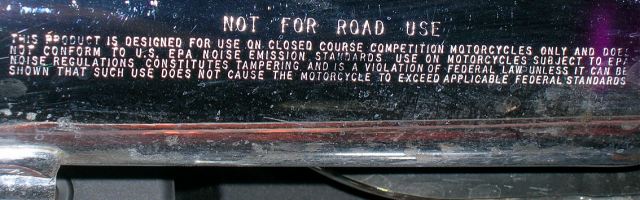
- Less common are mufflers labeled for competition-use motorcycles only. Photo of a competition-use muffler installed on a 2004 Harley-Davidson FXR street-use registered motorcycle. This muffler is currently legal for road use under PA vehicle equipment statutes and inspection code.
- The third type of illegal exhaust system consists of those that are correctly labeled but have been tampered with. By default, EPA-approved exhaust systems are quiet. Therefore, if police stop a loud federally regulated motorcycle with the correct muffler label, someone has obviously tampered with it to increase its noise emissions. Included in Appendix I are photos of some of the most common signs of tampering.
All of the above exhaust systems, when installed on a federally regulated motorcycle, constitute a violation of section 4909(a)(2) of the NCA. In addition, the absence of a muffler label is also a violation of section 4909(a)(1), which is applicable to manufacturers.
Lastly, attempting to swap EPA-approved mufflers from different makes and models is nearly impossible. Generally, motorcycle mufflers and exhaust systems are designed for a specific model. They are stylized to give the motorcycle a unique appearance. Muffler size and inlet location, as well as exhaust pipe size and mounting brackets, are all individualized. Even if mufflers could be cross-installed from different models, the resulting noise increases (if any) would be negligible due to the high degree of technology built into these mufflers.
- “Street motorcycle” (to include mopeds) means (as defined in 40 C.F.R. § 205.151(a)(2)) any motorcycle, regardless of engine displacement or horsepower, that can achieve (with a rider) at least 25 mph and is equipped with features such as, but not limited to, rear view mirrors, turn signals, horn, and lights.
- “Off-road motorcycle” (as defined in 40 C.F.R. § 205.151(a)(4)) means any motorcycle that is not a “street motorcycle” or “competition motorcycle.”
- “Competition motorcycle” (as defined in 40 C.F.R. § 205.151(a)(3)) means “any motorcycle designed and marketed solely for use in closed course competition events.”
- 40 C.F.R. § 205.169(a)(2)–(4).
- 40 C.F.R. § 205.158(a)(9)(a) (label for “competition motorcycle”).
- 40 C.F.R. § 205.152 (motorcycles); and 40 C.F.R. § 205.166 (aftermarket exhaust systems).
- This test procedure (J331a) measures the total noise (including exhaust, tire, wind, and engine mechanical noise) from the vehicle at 50 feet. The vehicle tested is in second gear at wide-open throttle, with the engine RPM at a pre-determined percentage of the engine’s maximum RPM. 40 C.F.R. pt. 205, Appendix I, contains this complex test procedure.
- This model-specific code includes a 3-character abbreviation of the manufacturer’s name, a unique model code, and the engine displacement in cc (3 to 4 digits).
- See infra note 12-17.
Copyright © 2004-2026 NoiseOFF. All rights reserved. Read our Privacy Policy.