
An independent public resource on environmental noise pollution, including its sources, health impacts, history, and solutions.
Home / Publications / Loud Motorcycles / Response to Opposition to Motorcycle Noise Legislation
Response to Opposition to Motorcycle Noise Legislation
In Response to Concerned Citizens for Motorcycle Safety (CCMS) Presentation Opposing Intro 416-A
My name is Jeff McCulley. I am a veteran motorcycle mechanic and author of Loud Motorcycles at NoiseOFF. After reviewing the presentation by Concerned Citizens for Motorcycle Safety (CCMS), they contend the federal muffler labeling law is flawed and that if the New York City Council passes Intro 416-A, it would harm owners of motorcycles with EPA-compliant exhaust systems.
This is not the case, nor is it the true intention of this group to protect motorcyclists with stock EPA exhaust systems.
As a motorcycle mechanic for the last twenty years, routinely seeing 1,000+ motorcycles pass through our shop every year, I can assure council members that I have never seen an EPA-compliant original equipment exhaust system without the correct label as required by federal law. On a few select models, the muffler label is not obviously present; however, upon closer inspection, finding the EPA approval label on a motorcycle exhaust muffler takes less than a minute.
CCMS does acknowledge the illegality under federal law of aftermarket exhaust systems “…yes straight pipes do not have an EPA stamping…”[1]. However, aside from poor-quality pictures, they resorted to literary subterfuge in their survey of stock motorcycle exhaust systems.
They conclude “only 65% (45 out of 69 motorcycles) of the motorcycles surveyed had an EPA stamping that could be found”[2], inferring that 35% (or 24) brand-new motorcycles have no EPA stamp. However, another section of their presentation states that they found EPA stamps on all 69 of the motorcycles surveyed: “of these 69 motorcycles, 24 did not have an EPA stamping that could be found without dismantling the motorcycle”[3]. They claim they had to dismantle the motorcycle to locate the EPA stamp.
We present photo examples of EPA stamps for motorcycle exhaust systems that CCMS claims are not there, not plainly visible, or require dismantling the motorcycle to locate them.
Examples of EPA labels “not found” by CCMS
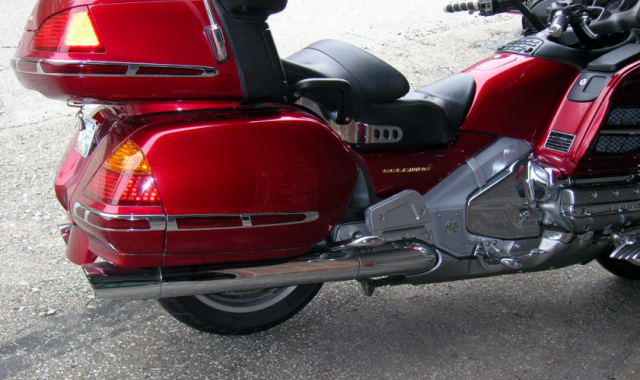
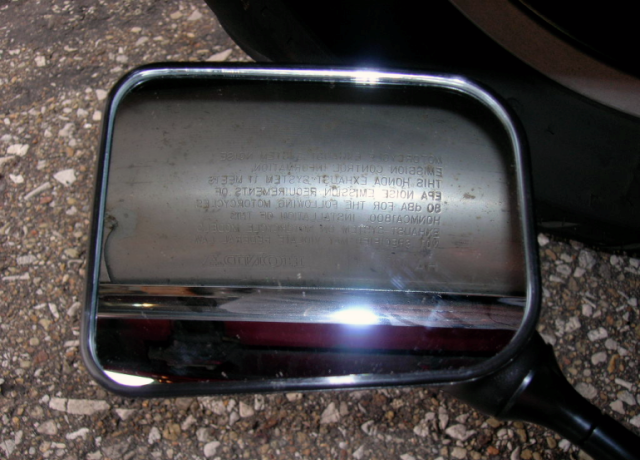
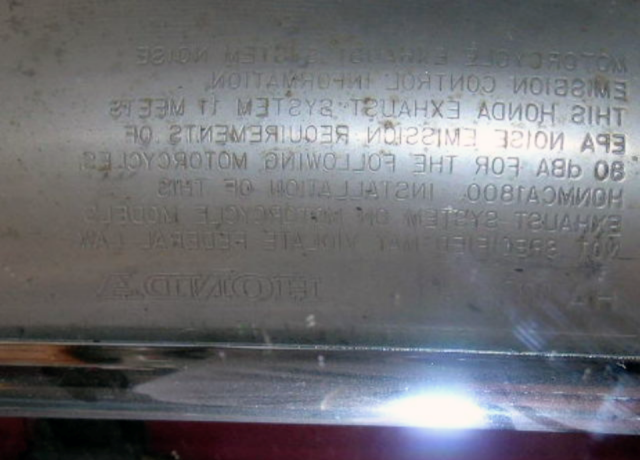
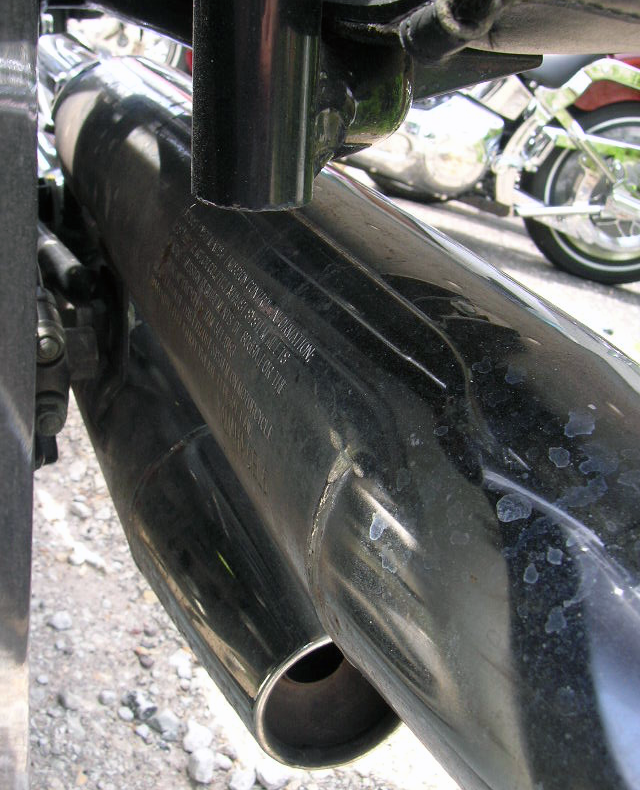
This is a 2008 Honda GL1800 Gold Wing. The label faces downward because the sides and top of the muffler are partially encased in a chrome heat shield. A simple mirror can easily be used to inspect any motorcycle exhaust system for the presence of an EPA label. This muffler, Honda (PN#18305-MCA-A20), has been in use on this model since 2004 and is also in use on the 2009 model.
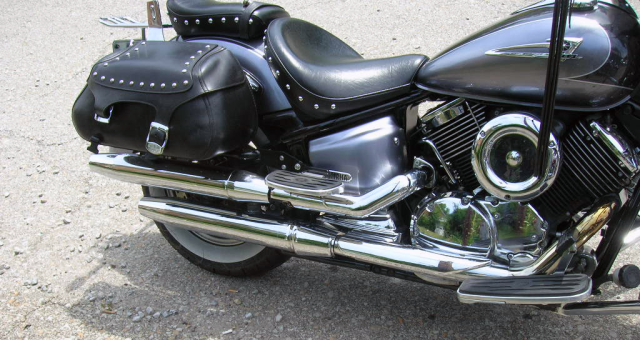
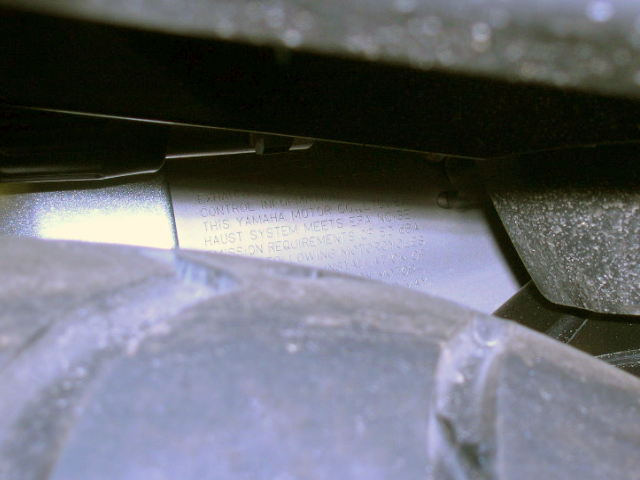
This is a 2004 Yamaha XV1100 Custom (below). This model exhaust system (PN#5YS-14710-00-00) fits all Yamaha V-Star 1100 models (Classic, Silverado, and Custom) made from 2006 through 2009 (and since 2004 in California). Even though the label is on the tire side of the muffler and covered in road grime, the label is still visible. Since new motorcycle air emissions regulations (Tier 1) took effect in 2006 (2004 in California), this muffler also contains a catalytic converter and is part of the air pollution emissions control system.
This is the label for a 2008 Yamaha VMAX (below). This photo was taken from the right side of the vehicle, looking across and in front of the rear tire at the tire side of the muffler. The label is plainly visible.
Here are the labels for a 2008 Suzuki GSX-R1000 (below). This model has dual mufflers. Although the EPA labels are on the tire side of the mufflers, they are still in a plainly visible position. These photos were taken two feet behind the vehicle. These mufflers (PN: 14310-21H00-H01 [RH] and PN: 14340-21H00-H01 [LH]) are installed on the 2007 and 2008 model years.
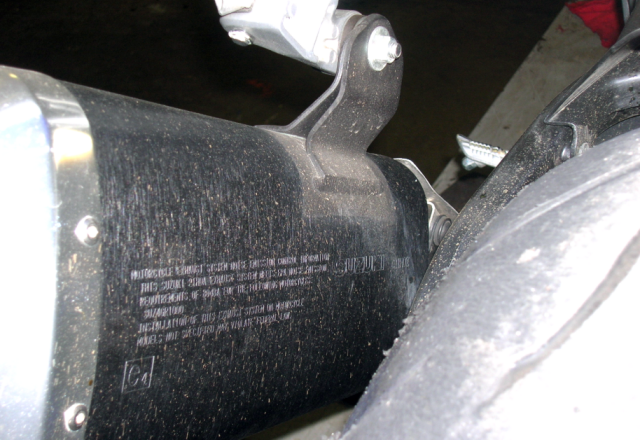
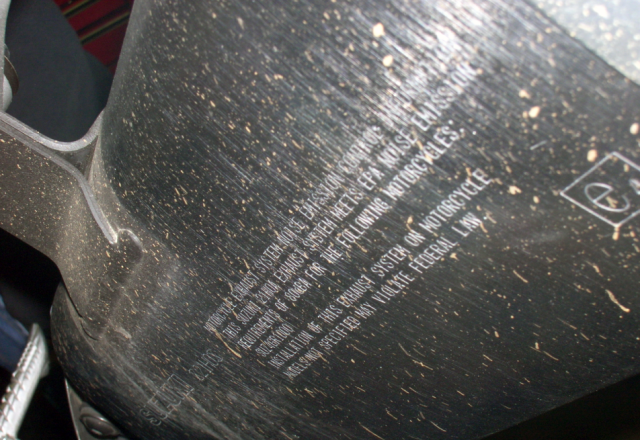
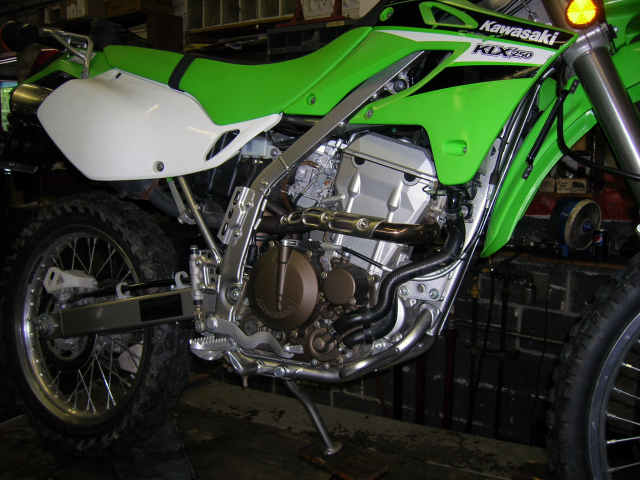
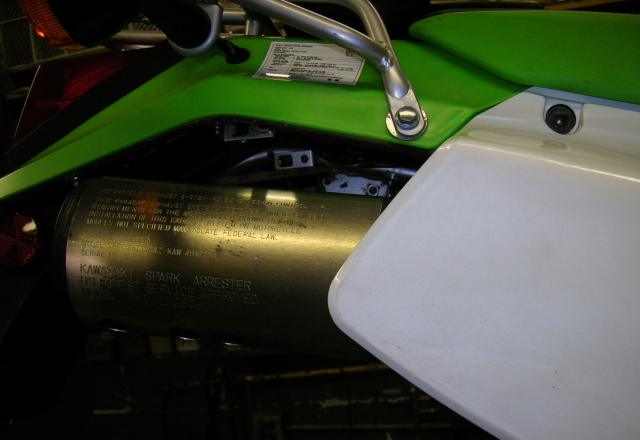
Here is the 2007 Kawasaki KLX250S (PN#18091-0238); CCMS did not specify which model year motorcycle they inspected that they claimed did not have an EPA stamp.
Here is the 2003 Suzuki SV650 with the stock exhaust system. The muffler (PN: 14305-17G70-H01) fits all 2003–2008 SV650, SV650A, SV650S, and SV650SA models.
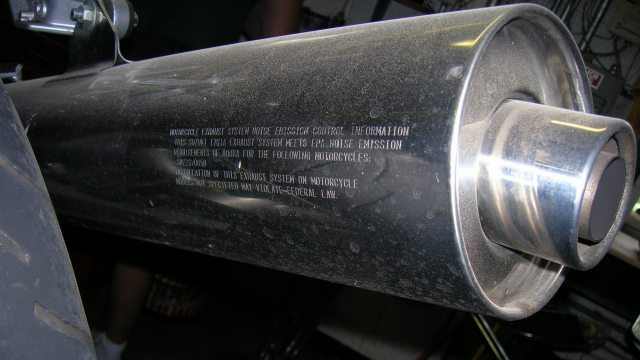
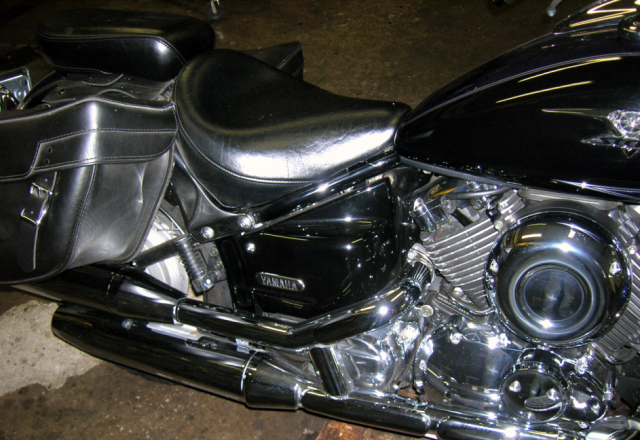
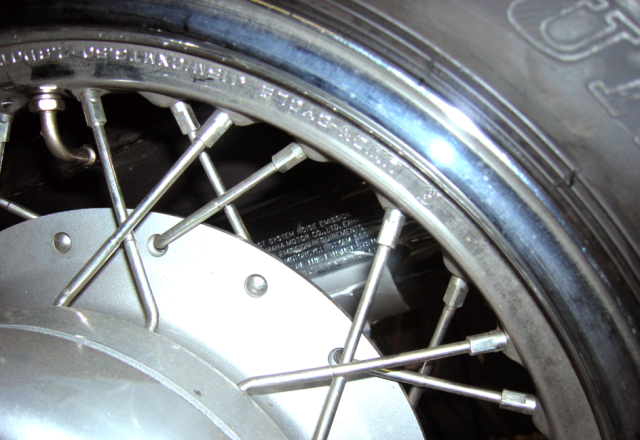
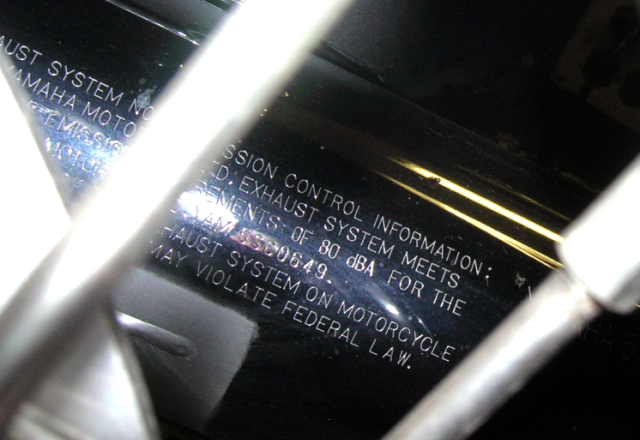
Here is the label for the 2006 Yamaha V-Star Classic (XV650C). This exhaust system (PN: SSC-14704-10-00) fits all 2004–2006 V-Star 650 models (Classic, Silverado, and Custom). The EPA label (below) faces the tire side but can be easily viewed through the wheel spokes—even with large saddlebags installed on both sides.
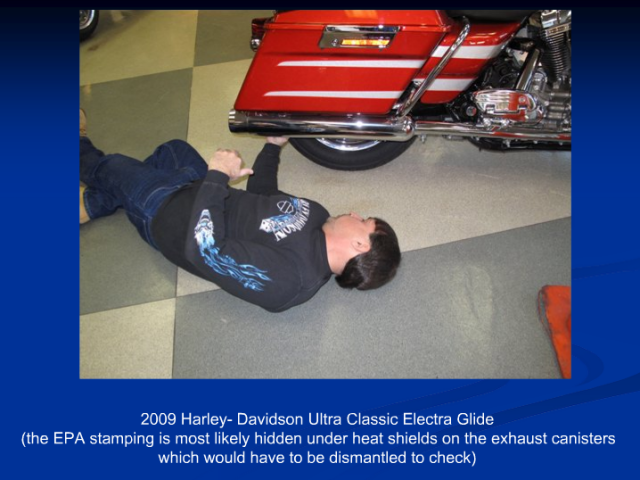
The CCMS presentation included this slide (below) suggesting that the EPA stamp is hidden under heat shields on the exhaust canisters. The problem with that theory is that this exhaust system has no heat shields.
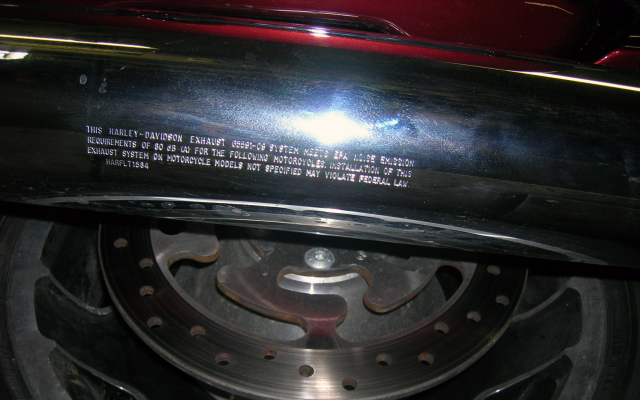
Here is the same motorcycle and exhaust system (below). We had no trouble locating the EPA stamp.
On the subject of heat shields, this is a 2005 Harley-Davidson FLST with a heat shield on the exhaust system (below). Even with the heat shield, the EPA stamp is clearly visible.
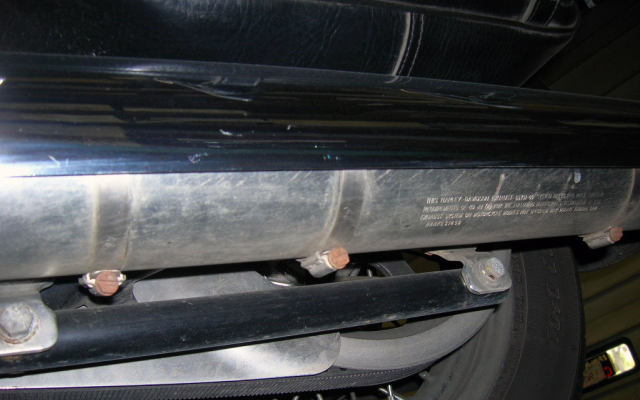
This is another Harley-Davidson original equipment heat shield (held on by band clamps). CCMS falsely claims the heat shield must be removed to see the EPA label.
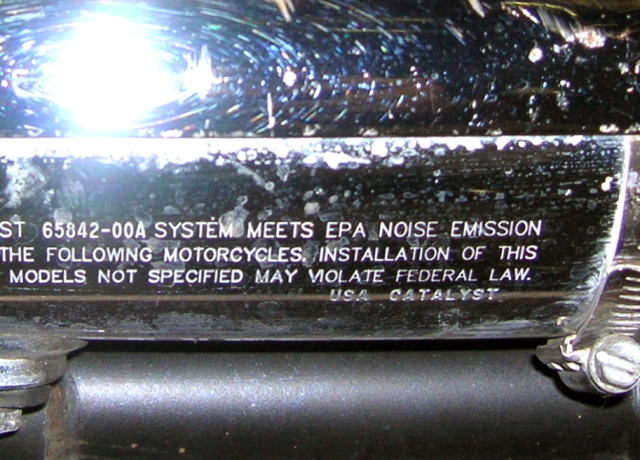
CCMS would have council members believe that passing bill 416-A would punish owners of EPA-compliant motorcycles based merely on the issue of plainly visible labels, as if owners are responsible for muffler label placement, and imply that these owners would have no recourse or protections under the law. This is simply not true.
The group failed to mention that any owner of a new federally regulated motorcycle is protected by a “noise emissions warranty” that covers manufacturer defects regarding noise emissions regulations for one year at no cost to the original owner (42 U.S.C. § 4905(d)). This warranty applies to aftermarket exhaust systems as well (40 CFR § 205.173-1). In addition, any motorcycle owner who was sold a defective product (an unlabeled exhaust system) may also sue the manufacturer for breach of warranty under the federal Magnuson–Moss Act in state court.
There are many clear warnings informing motorcycle owners of illegal acts. In addition to the tampering warning label placed on the original equipment exhaust system, the motorcycle owner’s manual includes the following statement:
“Tampering with Noise Control System Prohibited”
The removal or rendering an operative by any person other than for the purposes of maintenance, repair, or replacement, of any device or element of design incorporated into any new vehicle for the purpose of noise control prior to its sale or delivery to the ultimate purchaser or while in use, or (2) the use of the vehicle after such device or element of design has been removed or rendered inoperative by any person” along with specific acts identified by the manufacturer that are regarded as tampering.
The bill mirrors federal regulations, which all motorcycle manufacturers and aftermarket parts manufacturers must comply with in order to sell within the U.S. This bill also follows the intent of Congress to “promote an environment for all Americans free from noise that jeopardizes their health or welfare.”
Copyright © 2004-2026 NoiseOFF. All rights reserved. Read our Privacy Policy.