
An independent public resource on environmental noise pollution, including its sources, health impacts, history, and solutions.
Home / Publications / Loud Motorcycles / The Myth of “Environmentally Friendly Motorcycles”
The Myth of “Environmentally Friendly Motorcycles”
In addition to being major sources of environmental noise pollution on par with commercial trucks, motorcycles are also major contributors to air pollution.
According to the EPA, under the 20-year-old motorcycle air emissions standard (prior to the 2006 model year), “today’s motorcycles produce more harmful emissions per mile than a car or even a large sport utility vehicle”[1]. “…The current [pre-2006] federal motorcycle standard for hydrocarbon emissions is about 90 times higher than the hydrocarbon standard for today’s passenger cars”[2]. Motorcycles have much higher emissions than cars on a per vehicle basis as well. “A highway motorcycle driven 10 miles emits as many hydrocarbon emissions as a current passenger car driven 210 miles”[3]. In 2004, all passenger cars, light trucks, and SUVs (referred to as LDVs, or Light-Duty Vehicles) were required to meet even more stringent federal air emissions standards which, in effect, made a large SUV 95% cleaner than the typical motorcycle at that time[4].
One might assume newer motorcycles will be equal to comparable-year LDVs regarding emissions, but this would be wrong. “Even after the second tier of motorcycle regulations take effect in 2010, motorcycle emissions standards will still be several times higher than those for cars and light trucks”[5]. How much higher? 2010 model-year motorcycle HC+NOx (HC hydrocarbon; NOx mono-nitrogen oxides) emissions limits are 4 times higher than the dirtiest 2008 LDV (bin 8) standard and 14 times higher than the 2008 LDV fleet average standard (bin 5). Also, motorcycle carbon monoxide (CO) standards are 4.6 times higher than the LDV fleet average as well[6].
Another major disparity between LDVs and motorcycles is the amount of pollution they can emit over their useful life. Since 1994, LDVs are not allowed to exceed the federal standard for 10 years/100–120,000 miles, but motorcycle (Class 3[7]) emissions are only limited for 5 years/18,600 miles. It is generally assumed motorcycles have a very short life compared to LDVs, but according to the Motorcycle Industry Council (MIC), only 34% of motorcycles are retired after 10 years[8]. I can attest to this as well. We have a good number of customers with pre-2000 models that have 30 to 60k miles on them. This means that a good number of the motorcycles on the road are well past their useful life and are exceeding their emissions limits roughly by 7%[9] for every 18,600 miles they go past their designed useful life.
The new standards for 2006 (Tier 1) model-year motorcycles forced many manufacturers to start using oxidized catalyst (OC) or three-way catalyst (TWC) catalytic converters in their exhaust systems to control air emissions for many of the large displacement (Class 3) motorcycles. Currently, 72% of Class 3 EPA-certified 2009 models use some type of catalytic converter[10]. In 2006, 48% and in 2005 only 35% utilized catalytic converters[11]. The clear trend toward greater use of catalytic converters in motorcycle exhaust systems is likely to continue next year as the final motorcycle emissions standard takes effect.
On many models, the catalytic converter is part of the exhaust system prior to the muffler, but on some models, like the 2007 Yamaha XV1100, as well as many 2006 Harley-Davidson models, it is in the muffler itself.
Although new federal motorcycle air pollution standards took effect in 2006, and it continued to be a violation of federal law to tamper with, or even build, non-compliant equipment, I routinely see illegal aftermarket exhaust systems built without a catalytic converter, despite the fact they are specifically designed and marketed for motorcycle models that came with catalytic converters.
For example, this 2006 Harley-Davidson Softail Classic has been equipped with an aftermarket Vance and Hines Long Shots exhaust:
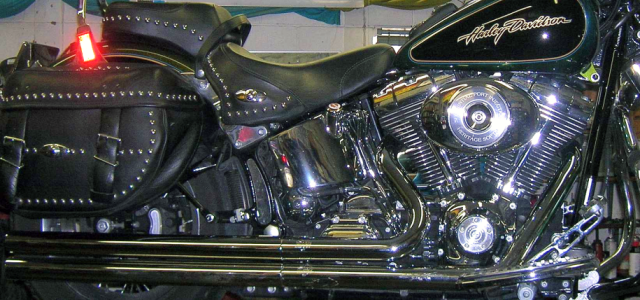
According to the “Emissions System Control Information”[12] label on the motorcycle (see box below), it is required to have an oxidized catalyst (OC) catalytic converter to meet federal air emissions standards. However, there are no catalytic converters in these aftermarket pipes. If you are following one of these bikes in traffic or walk by one that is driving down the street, you will immediately notice the noxious smell of raw unburned gasoline, also known as hydrocarbons (HC). The pollution is comparable to an early 1970s-era car[13].
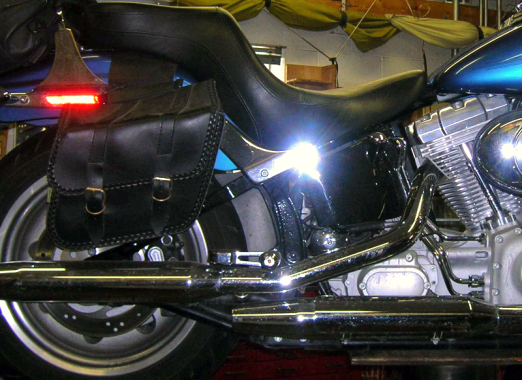
The Harley-Davidson motorcycle (above) originally shipped with a factory exhaust system as shown (below). The 2006 Harley-Davidson FXST Softail Standard has oxidized catalyst (OC) catalytic converters built into the muffler.
- EPA Regulatory Announcement, EPA Finalizes Emission Standards for New Highway Motorcycles, EPA 420-03-044, at 1.
- Id., at 3.
- EPA, Final Regulatory Support Document: Control of Emissions from Highway Motorcycles, EPA 420-R-03-015, at 1-44.
- Supra note 1, at 3.
- EPA, Summary and Analysis of Comments: Control of Emissions from Highway Motorcycles, EPA 420-R-03-016, at 6.
- Id., see p. 5.
- Class 3 motorcycles are above 279 cc and represent 93% to 95% of all motorcycles sold annually. See note 3, at 2-5.
- See note 6, at p. 43.
- The 7% figure is based on an average of all Class 3 motorcycle “deterioration factors” for HC, provided in the EPA Annual Certification Test Results from the 2005 and 2006 model years. In 2005, 200 bikes had an average DF of 1.06, and in 2006, 52 bikes had an average DF of 1.09.
- Data extrapolated from EPA motorcycle Annual Certification Test Results, which include entries for “Catalyst Type” and “Catalyst Y/N,” formally available at the EPA’s “Annual Certification Test Results & Data” page.
- Data extrapolated from the Annual Certification Test Results. Id.
- 40 C.F.R. § 86.413-2006 (“Labeling”).
- EPA, Summary of Current and Historical Light-Duty Vehicle Emissions Standards.
Copyright © 2004-2026 NoiseOFF. All rights reserved. Read our Privacy Policy.