
An independent public resource on environmental noise pollution, including its sources, health impacts, history, and solutions.
Home / Noise Sources / Motorcycles
Motorcycles
In the United States, motorcycles are manufactured to comply with federally mandated noise control standards. Excessive motorcycle noise results from modified or aftermarket exhaust systems that are not street legal.
Amplified exhaust noise can travel long distances, penetrate buildings, and be felt as vibration. Its impact often extends far beyond the roadway and into surrounding residential areas.
The use of illegal exhaust systems by a minority of riders negatively affects public perception of motorcycling as a whole. Many riders use and support compliant exhaust systems and recognize that unnecessary noise undermines motorcycling’s standing within communities.
Some riders argue that louder exhaust systems improve safety under the slogan “loud pipes save lives.” However, no credible study has demonstrated a correlation between increased exhaust noise and reduced accidents. Motorcycles are already equipped with standard safety devices, including horns, intended to alert other motorists when necessary.
Motorcycle exhaust noise radiates rearward from the exhaust outlet. Because most multi-vehicle motorcycle collisions occur in front of the motorcycle, increased exhaust noise provides no practical warning to oncoming vehicles.
The National Highway Traffic Safety Administration (NHTSA) collects and publishes comprehensive data on motorcycle crashes and roadway safety.
In their 2007 published report, ‘Fatal Two-Vehicle Motorcycle Crashes’ (DOT HS 810 834), motorcyclists were identified as the striking vehicle in nearly three-fourths of two-vehicle crashes involving passenger vehicles. In nearly three-fourths of the two-vehicle motorcycle crashes involving passenger vehicles, the role of the motorcycle was recorded as the striking vehicle. Additionally, factors including alcohol impairment, invalid license, and speeding were more attributed to motorcycle riders.
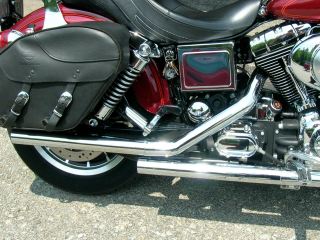
Straight Pipe Exhaust
An exhaust configuration not installed by motorcycle manufacturers on street-legal production motorcycles. Straight-pipe systems are designed to maximize exhaust output and typically exceed current EPA noise emission standards.
Industry
Major motorcycle manufacturers include Harley-Davidson Motor Company (H-D), Suzuki, Kawasaki, Yamaha, Honda, and BMW. Prominent manufacturers of aftermarket motorcycle exhaust systems include Samson Motorcycle Products, Vance & Hines, Yoshimura, D&D, and Kerker.
Industry trade associations such as the Motorcycle Industry Council (MIC) and the Specialty Equipment Market Association (SEMA) represent manufacturers, dealers, and installers.
These organizations have lobbied against proposed noise-pollution ordinances at the local, state, and federal levels. SEMA established the Congressional Automotive Performance and Motorsports Caucus to promote industry policy positions and has encouraged participation from affiliated businesses and enthusiast organizations in legislative advocacy.
With increasing negative news stories and noise code legislation targeted at the motorcycle community, H-D discontinued manufacturing non street-legal exhaust pipes using the brand name ‘Screamin’ Eagle.’
Harley-Davidson also sought to trademark the sound of its V-twin motorcycle engines. Ken Schmidt, a former company executive, publicly described the engine sound as the “Voice of God” and stated during a business conference, “Noise is good. Noise is the foundation of your business.”
Some riders participate in motorcycle rights organizations (MROs) that oppose motorcycle-specific noise legislation. These organizations include the Motorcycle Riders Foundation and the American Motorcyclist Association (AMA). In many regions, groups operating under the name ABATE advocate on motorcycle-related policy issues; the meaning of the acronym varies by chapter, including “American Brotherhood Aimed Toward Education” or “American Brotherhood Against Totalitarian Enactments.”
Motorcycle Exhaust Noise in Boston
Factory-installed motorcycle exhaust systems are designed to meet EPA noise standards. However, these systems are frequently replaced with aftermarket exhausts. A general manager at a Boston-area Harley-Davidson dealership stated that an estimated 60 to 70 percent of riders replace their factory-installed exhaust systems.
Legislation
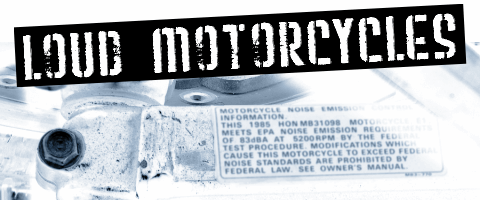
The Environmental Protection Agency (EPA) sets federal noise emission standards for motorcycle exhaust systems. The maximum allowable noise level for street-legal motorcycle exhausts is 80 dB(A). Motorcycles are required to display EPA compliance labeling on the chassis and exhaust system. Because accurate roadside noise testing is complex and impractical for most law enforcement agencies, the EPA labeling system serves as a primary regulatory mechanism for states and municipalities to control motorcycle noise.
Loud Motorcycles
A simple and effective regulatory measure for states and municipalities to control motorcycle noise by utilizing the EPA’s dormant “label match-up” program.
Riders may legally purchase and install aftermarket exhaust systems, provided those systems comply with EPA noise emission requirements. However, many aftermarket exhaust systems are not street legal and are marketed for off-road or closed-course competition use only.
The California Air Resources Board estimates that a motorcycle with its catalytic converter removed can emit up to ten times the amount of smog-forming pollutants. The removal or modification of emissions-control equipment—often performed to increase exhaust noise—contributes to both air pollution and excessive noise levels.
Affected residents experiencing ongoing motorcycle noise are increasingly engaging with elected officials to seek improved legislation and more effective enforcement. At the same time, restrictions on motorcycle activity have expanded across public lands, private roads, and gated communities.
In several traditional motorcycle destination cities, including Daytona, Myrtle Beach, and Laconia, public hearings have been held to address the impacts of large-scale motorcycle events. Some residents report leaving their homes during major rallies due to sustained noise levels and traffic congestion.
The American Motorcyclist Association (AMA) represents more than 200,000 members and over 1,100 chartered clubs, with corporate participation from segments of the motorcycle industry. Through organized campaigns and sponsored events, the organization mobilizes its membership to influence policy discussions related to motorcycle regulation, including noise legislation.
Since the early 2000s, municipalities across the United States have explored and adopted EPA exhaust-label enforcement as a practical tool for addressing motorcycle noise. Some jurisdictions implemented these measures successfully, while others repealed or modified them following legal challenges, economic pressure, or industry lobbying. These outcomes reflect an ongoing tension between community noise impacts, enforcement practicality, and organized opposition rather than a lack of regulatory authority.
In response to increasing support among municipalities in EPA exhaust-label enforcement, the American Motorcyclist Association (AMA) established the Motorcycle Sound Working Group.
The group convened a National Summit on Motorcycle Sound that included representatives from motorcycle manufacturers, the aftermarket industry, and racing organizations. The stated goal was to develop alternative approaches to motorcycle noise regulation. In 2009, the Society of Automotive Engineers (SAE) introduced a new stationary test procedure for street motorcycles, designated SAE J2825, titled “Measurement of Exhaust Sound Pressure Levels of Stationary On-Highway Motorcycles.”
The SAE J2825 standard, developed by the SAE Motorcycle Technical Steering Committee, recommends allowable sound levels ranging from 92 to 100 dB(A). Because decibel levels are measured logarithmically, these limits permit sound levels many times higher than existing federal manufacturing noise standards.
The procedure requires law enforcement officers to conduct a stationary sound test using a sound-level meter positioned at a specified angle and distance from the exhaust outlet while the motorcycle operator gradually increases engine speed from idle.
In communities where law enforcement is mandated to use sound meters to determine motorcycle noise violations, enforcement is often limited. Sound-level meters are costly, require regular calibration and maintenance, and officers must be trained to follow precise testing procedures. Real-world conditions—such as traffic, wind, and ambient noise—can interfere with accurate measurements. As a result, citations are frequently challenged in court and may be dismissed due to procedural or technical deficiencies.
Industry-developed measurement standards such as SAE J2825 have been criticized by public officials and noise-control advocates for prioritizing laboratory-style testing over practical enforcement. The complexity of these procedures can make consistent field enforcement difficult, limiting their effectiveness as a tool for protecting public health and community noise standards.
An alternative enforcement approach used by some jurisdictions is the “plainly audible” standard, which allows an officer to determine excessive noise based on audibility at a specified distance without the use of specialized equipment.
See Also
Health
Research, public health findings, sound measurement, and the effects of noise on sleep, stress, hearing, cardiovascular health, and learning.
Copyright © 2004-2026 NoiseOFF. All rights reserved. Read our Privacy Policy.